
By Keshavan Thiagaraja
When I work with organisations on Digital Transformation and Business Process Re-engineering, I often ask one question early: how much of your planning depends on historical pattern repetition rather than genuine forward reasoning?
A group of 18-year-old students in the UK recently answered that question more forcefully than any boardroom presentation I have seen.
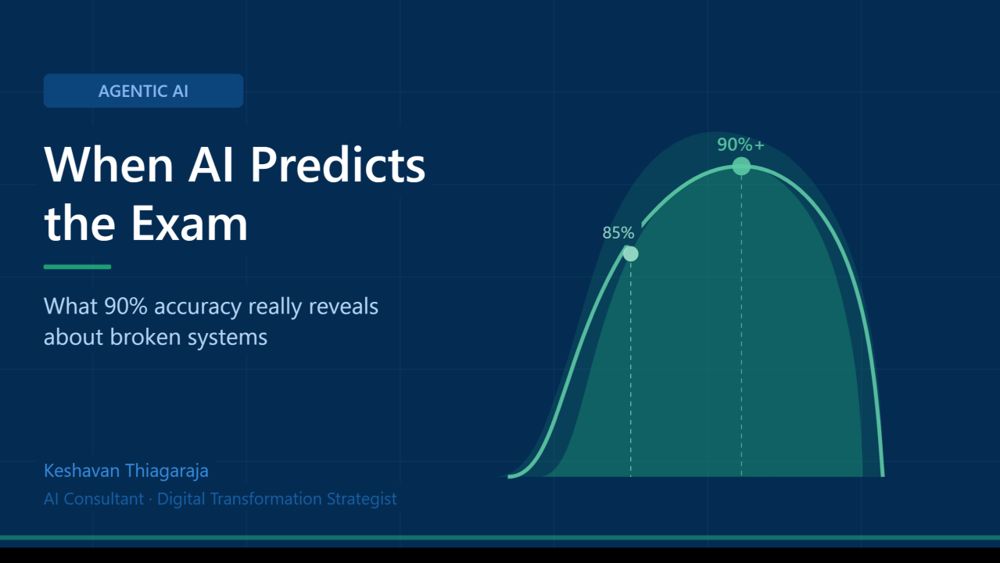
Using 20 years of GCSE and A-Level exam papers, mark schemes, examiner reports, and curriculum documents, they built an AI system that predicted exam questions with over 90% accuracy. Last year the system reached 85%. This year it exceeded 90%. The improvement was not accidental. It was a feedback loop working exactly as designed.
Most people read this as a story about AI. I read it as a story about systems.
The Architecture Is Not New
Let us be precise about what they built. The system draws on three layers: a data ingestion layer processing two decades of historical papers and examiner commentary, a pattern recognition layer using large language models to model topic cycles and coverage gaps, and a probabilistic output layer producing ranked predictions weighted by historical recurrence.
This is Retrieval-Augmented Generation applied to temporal pattern prediction. The same architectural logic appears in financial forecasting, retail demand planning, fraud detection, cybersecurity analytics, and supply chain optimisation.
The domain changes. The mathematics does not.
What 90% Accuracy Actually Exposes
If a system trained on historical data can predict examination questions with over 90% accuracy, that is not primarily evidence of sophisticated AI. It is evidence of a structurally deterministic assessment system.
A well-designed examination should be highly resistant to historical pattern prediction. If 20 years of data can tell you what appears on next year's paper with 90% confidence, the system is measuring recall and pattern matching, not genuine understanding.
The students did not break the examination system. They made visible what was already broken.
The same flaw exists in business. Annual planning cycles that reproduce last year's assumptions. Performance frameworks that reward behaviours valued in a previous competitive environment. Strategic intelligence processes with no mechanism to detect structural change. These are not different problems. They are the same problem in different domains.
What Organisations Must Now Confront
The organisations that will build durable competitive positions are not those that restrict what their people can use. They are those that redesign their processes to reward what AI genuinely cannot replicate: novel synthesis across unfamiliar domains, ethical judgement in ambiguous situations, cross-domain creativity, and the discipline to ask better questions rather than generate faster answers.
If your strategy, planning, or decision-making can be predicted with 90% accuracy from historical data, AI is not your biggest challenge.
Originally published on LinkedIn by Keshavan Thiagaraja. Read the original on LinkedIn.